The Longest-Throw Fenix Flashlights: Reach, Not Lumens
Here is the fact that breaks most people's flashlight instincts. The Fenix TK30 puts out 500 lumens. The Fenix LR50R V2.0 puts out 18,000. The TK30 throws its beam 1,200 metres; the LR50R V2.0 manages 846. A light with one thirty-sixth the output reaches 350 metres further.
That is not a manufacturing quirk. It is the entire distinction between how much light a flashlight makes and where it puts it — and it is why shopping for reach by reading lumen figures gets you the wrong light. This guide ranks the Fenix line by beam distance and candela, explains what those numbers mean, and covers what long throw costs you in return. Everything ships from Mississauga, Ontario with Fenix warranty service handled in Canada; prices are in Canadian dollars.
The short version
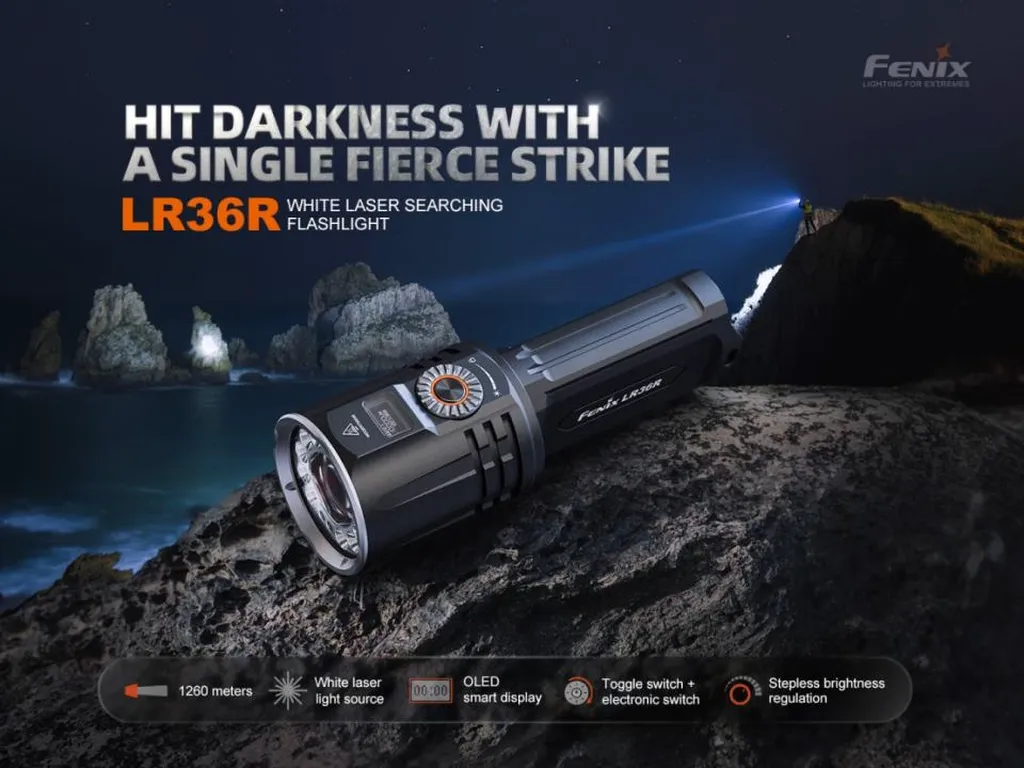
- Farthest throw: LR36R — 1,260 m, and a 10,000-lumen flood in the same body, $529.95
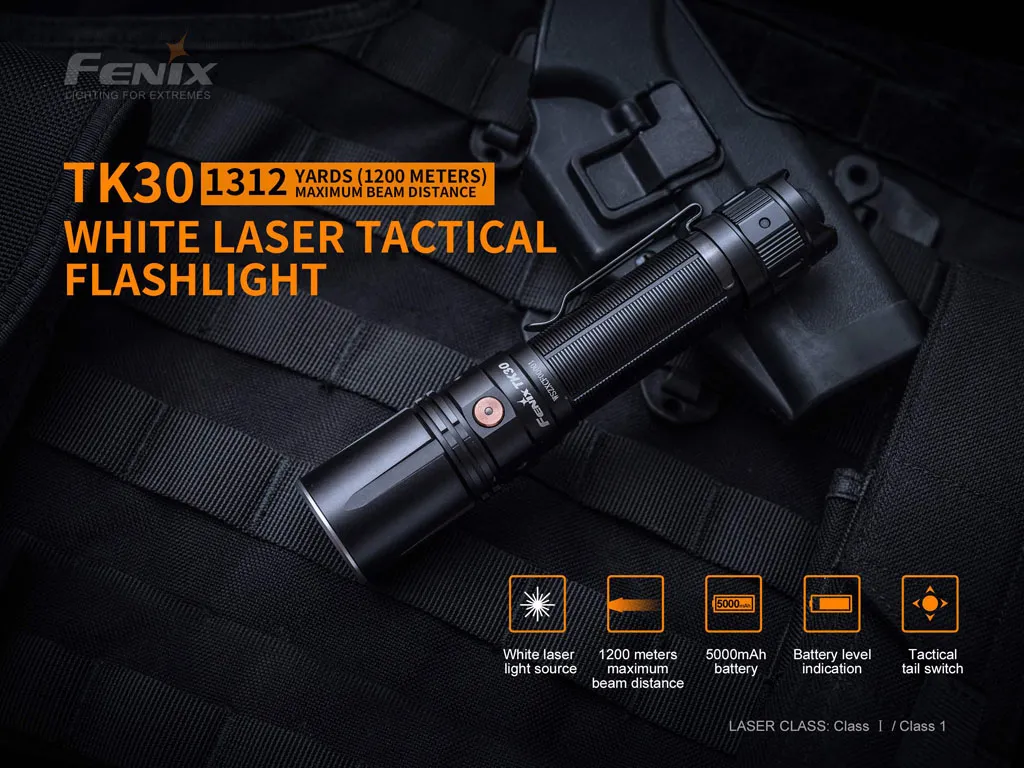
- Most reach per gram: TK30 — 1,200 m at 216 g, $369.95
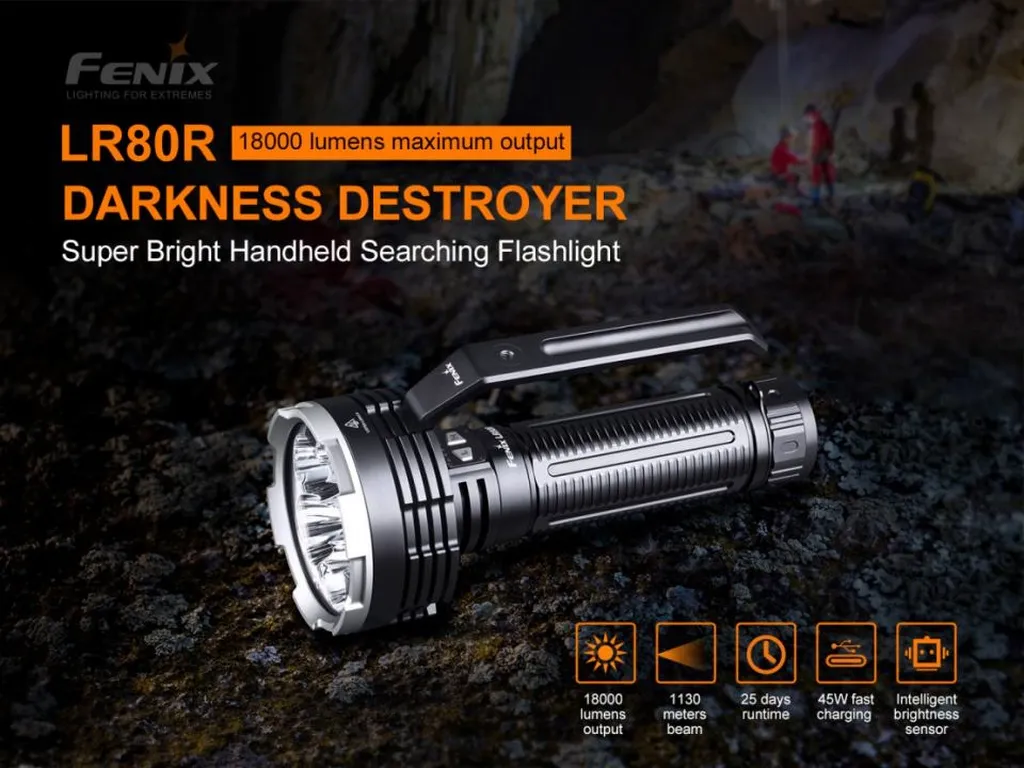
- Best all-rounder: LR80R — 1,130 m and 18,000 lm, $616.95
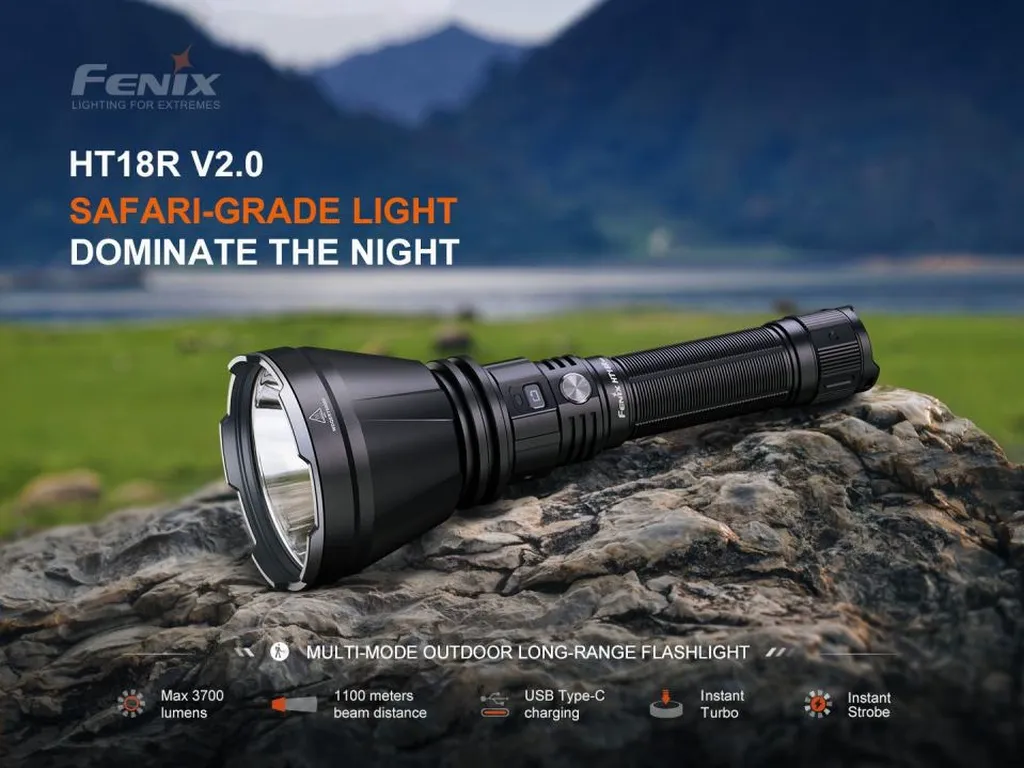
- Best value: HT18R V2.0 — 1,100 m for $219.95
- Every light on this page is over $99, so all of them ship free within Canada.
Want raw output instead? If your problem is lighting a wide area rather than reaching a distant one, the ranking you want is the brightest Fenix flashlights.
Beam distance and candela, in one minute
Two specs describe reach, and they are the same fact stated twice.
Candela is beam intensity — how much light is concentrated into the hotspot at the centre of the beam. It is the honest, primary measurement.
Beam distance is candela translated into metres. Under the ANSI/NEMA FL1 standard, it is the distance at which the beam still delivers 0.25 lux — roughly the illumination of a clear full moon. The arithmetic is simply distance = 2 × √candela. Run it on the LR36R: the square root of 396,600 is about 630, doubled is 1,260 m — exactly the figure on the box.
The part worth internalising: 0.25 lux is detection light, not working light. At a light's rated beam distance you can tell that something is there. To positively identify what it is, plan on roughly half that number. A 1,200 m thrower is a 600 m identification tool, and that is still a great deal more than most flashlights manage.
Lumens still matter to a thrower — they just are not the ranking spec. For the full explanation of how the two interact, see how to read a flashlight beam spec sheet.
The longest-throw Fenix flashlights, ranked
| Rank | Model | Beam distance | Peak candela | Output in that mode | Emitter | CAD |
|---|---|---|---|---|---|---|
| 1 | LR36R | 1,260 m | 396,600 cd | 350 lm over 4 h 3 min | White laser | 529.95 |
| 2 | TK30 | 1,200 m | 363,866 cd | 500 lm over 3 h | White laser | 369.95 |
| 3 | LR80R | 1,130 m | 318,000 cd | 18,000 lm over 2 h | LED | 616.95 |
| 4 | HT18R V2.0 | 1,100 m | 268,000 cd | 3,700 lm over 2 h | LED | 219.95 |
| 5 | LR60R | 1,085 m | 294,267 cd | 21,000 lm over 1 h 50 min | LED | 589.95 |
| 6 | LR40R V2.0 | 900 m | 203,568 cd | 15,000 lm over 2 h 30 min | LED | 419.95 |
| 7 | LR50R V2.0 | 846 m | 178,864 cd | 18,000 lm over 3 h 10 min | LED | 539.95 (pickup only) |
| 8 | HT32 | 640 m | 101,000 cd | 2,500 lm over 1 h 50 min | LED, multi-colour | 224.95 |
| 9 | GL30R | 630 m | 100,000 cd | 800 lm over 2 h 15 min | LED, rail-mounted | 234.95 |
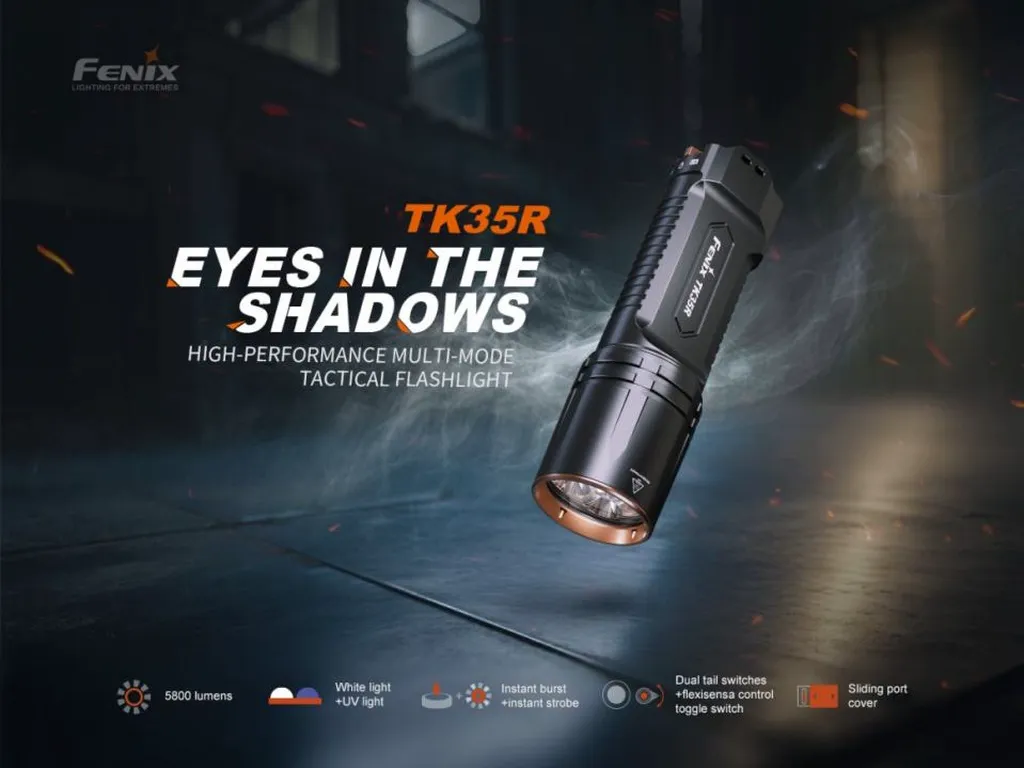
| 10 | TK35R | 610 m | 93,000 cd | 5,800 lm over 3 h | LED, plus UV | 289.95 |
Candela and beam distance are both published manufacturer figures. Most of the line is internally consistent with distance = 2√candela; a few models round the two independently, so the HT18R V2.0's 268,000 cd works out slightly short of its stated 1,100 m. Where they disagree, treat candela as the comparable number.
Read the output column across the top four rows and the point makes itself: 350 lumens, 500 lumens, 18,000 lumens, 3,700 lumens — scattered at random, while beam distance falls in an orderly line. Output and reach are close to independent variables.
Note also who is missing. The LR35R PRO and LR35R are both 10,000-lumen lights and neither makes this list — they top out at 500 m because their power goes into a broad beam rather than a tight one. They are excellent lights. They are just not throwers, and they lead the output ranking instead.
LEP versus reflector: the real decision
The two lights at the top of the table work on a completely different principle from the eight below them.
LEP — Laser Excited Phosphor — fires a blue laser diode at a phosphor target, which converts it into white light from a source only a fraction of a millimetre across. A tiny source is what a reflector needs to produce a tight beam, so LEP lights achieve enormous candela from very little total output. The result is a pinpoint: a small, intense circle with almost no surrounding spill.
Reflector LEDs start from a much larger emitting surface, so the beam always carries a usable halo of spill around the hotspot. You lose some pure reach per gram and per watt, but you gain peripheral awareness — you can see the ground you are walking on while you are looking at something 800 m away.
Which to buy comes down to one question: do you need to see the distant thing, or do you need to work at distance? LEP for the first. Reflector for the second. And if the answer is both, the LR36R is the light that refuses to choose — a 10,000-lumen LED flood and a white-laser channel in one body, usable separately or together at 10,000 lumens and 1,250 m simultaneously.
Picks by job
Maximum reach per gram — Fenix TK30
1,200 m of throw in a 216 g flashlight, for $369.95. Nothing else in the lineup approaches that ratio. Only the LR36R reaches further, and it weighs more than twice as much; the 1,636 g LR80R — seven and a half times the TK30's weight — does not reach as far at all. Three modes and nothing else: 500 lumens at 1,200 m over 3 hours, 100 lumens at 600 m over 6 hours, and strobe. It runs a standard replaceable ARB-L21-5000U 21700 cell, is IP68 sealed, and is rated to a 1 m drop.
Be clear about what it is not. 500 lumens of tightly collimated white laser is a superb spotting instrument and a poor general-purpose light — there is very little spill, so it will not light the path at your feet. Carry it alongside something wide, not instead of it.
Reach with something to see by — Fenix LR36R
The most versatile light on this page. The laser channel alone delivers 1,260 m at 396,600 candela on 350 lumens over 4 hours. The LED channel alone floods 10,000 lumens across a wide area. Run them together and you get 10,000 lumens and 1,250 m at once for 2 h 27 min — a distant target lit and identified, with the intervening ground visible. At 493 g with a replaceable ARB-L21-5000 V2.0 cell, it is a genuine one-light answer for search work.
One light that does everything — Fenix LR80R
The longest-throwing conventional LED light Fenix makes: 1,130 m at 318,000 candela, while also putting out 18,000 lumens and stepping down to 12,000 over 2 h 15 min. Unlike the LEP lights, all that reach comes with a wide, bright spill that lets you actually work. The 12,000 mAh pack drops to a 50-lumen eco mode rated for 300 hours, so it doubles as an outage light. It is $616.95 and 1,636 g — you pay for it in dollars and in mass.
Best value thrower — Fenix HT18R V2.0
1,100 m and 268,000 candela for $219.95 puts this fourth on the list at a third of the price of the lights above it. 3,700 lumens at turbo, 1,000 lumens at 570 m over 3 hours as the mode you will actually live in, and a replaceable ARB-L21-6000 cell. 358 g. It is the light we recommend most often to people who need real reach and do not need a searchlight budget — property and acreage checks, shoreline and channel work from a boat, fence lines and outbuildings, SAR ground teams, and trail or route-finding across open terrain.
Throw with colour options — Fenix HT32
640 m of white throw at 101,000 candela, plus dedicated red and green channels — 400 lumens red, 1,400 lumens green. Red light preserves dark-adapted vision, which matters when you are alternating between scanning at distance and looking at a chart, a map, or your footing; the physics is covered in red light and night vision. 255 g, IP68, replaceable 21700 cell, $224.95.
Duty and marine compact — Fenix TK35R
610 m and 93,000 candela in a 342 g tactical body, with 5,800 lumens of burst output and a separate UV channel for inspection work. It steps down to 2,000 lumens at 370 m over 3 h 15 min. This is the one that fits a duty belt and a boat console rather than a gear bag.
What long throw costs you
- Spill, and therefore situational awareness. A tight beam is a tunnel. The narrower the hotspot, the less you see of everything around it — which is fine when you are glassing a shoreline and dangerous when you are walking. Throwers work best as the second light in a kit.
- Close-range usability. Point a 396,600-candela beam at a map, a tailgate or a boat deck and you get glare, not information. Every serious thrower in this list except the TK30 carries a flood mode for exactly this reason.
- Atmospheric conditions. Rated beam distance is a clear-air laboratory number. Fog, falling snow, rain and blowing dust scatter a tight beam badly, and the tighter it is the more it lights up the airborne particles right in front of you rather than the target. Plan on a fraction of the rated distance in weather.
- Where you may point it. At these intensities a beam is not harmless at the far end. Never direct a high-candela light at vehicles on a road, at people, or at aircraft. Canadian Aviation Regulations s. 601.20 prohibits projecting a directed bright light source into navigable airspace where it could create a hazard to aviation safety — anywhere in Canadian airspace, not only near airports — and the definition covers any directed source, coherent or not, so a high-candela flashlight is squarely inside it. It carries a $1,000 contravention fine, with administrative monetary penalties under the Aeronautics Act reaching $5,000 for an individual and $25,000 for a corporation.
How to choose
- Shop candela, not lumens. If the product page leads with lumens and buries beam distance, it is not a thrower. Beam distance in metres is the headline spec for this category.
- Halve the rated distance for identification. The ANSI figure is the range at which you can detect something. Recognising it takes roughly twice the light.
- Decide LEP or reflector before you compare prices. They are different tools sold in the same category. Pinpoint reach versus reach you can work under.
- Check the mode you will actually use. The TK30's 500 lumens is its maximum; the LR80R's 18,000 is a two-hour burst. Read the mode below turbo and its runtime.
- Pair it with a flood light. Nobody's long-range kit is one light. A thrower plus a wide-beam handheld or headlamp covers the whole job; a thrower alone covers half of it.
The full long-range and LEP range is on the long-range flashlights page, with high-output models on search lights. Every light here carries the Fenix warranty with service handled in Canada — check coverage or start a repair on our support page. Equipping a SAR team or a marine crew? Volume orders keep the kit consistent across the group, and you can contact us with the distance you actually need to cover and we will tell you which of these is enough.