The Brightest Fenix Flashlights You Can Buy in Canada
Lumens is the number everyone shops on and the number the industry is least honest about. The figure printed on the box is a burst — measured in the first thirty seconds, in a climate-controlled lab, on a light that has not yet had to deal with its own heat. Ninety seconds later you are usually somewhere else entirely.
This guide ranks the brightest flashlights in the Fenix line by maximum output, and then does the part almost nobody publishes: it puts the next mode down beside it, because that is the setting you will actually spend the night in. Everything here ships from Mississauga, Ontario with full Fenix warranty service handled in Canada, and prices are in Canadian dollars.
The short version
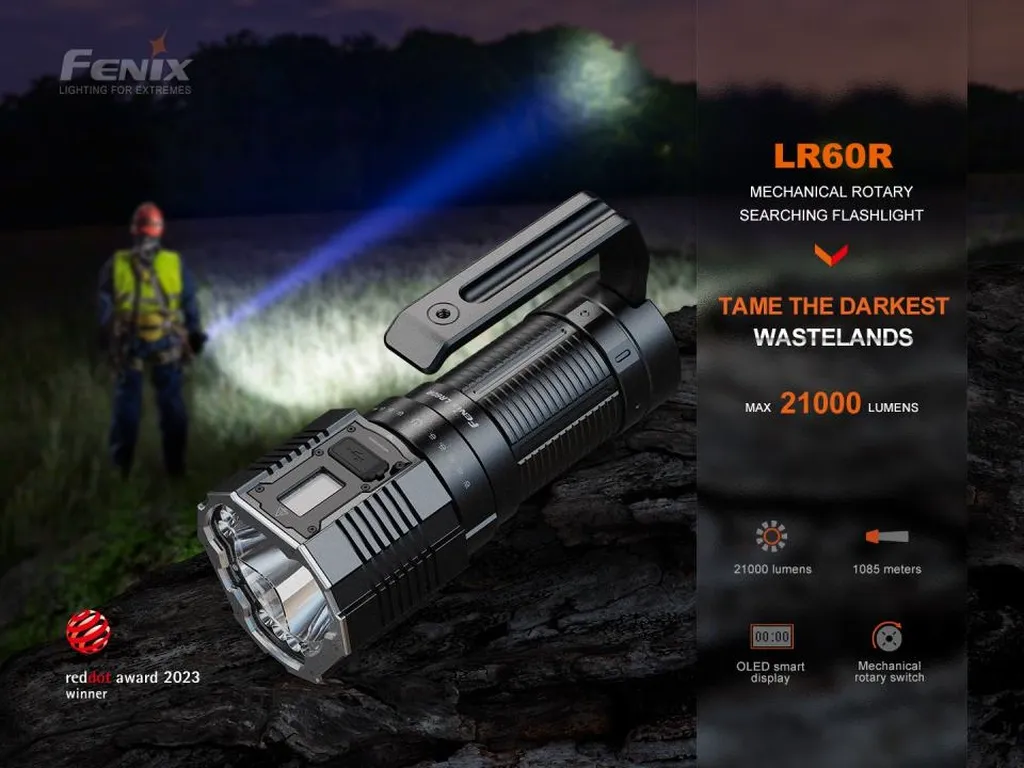
- Most lumens: LR60R — 21,000 lm, $589.95
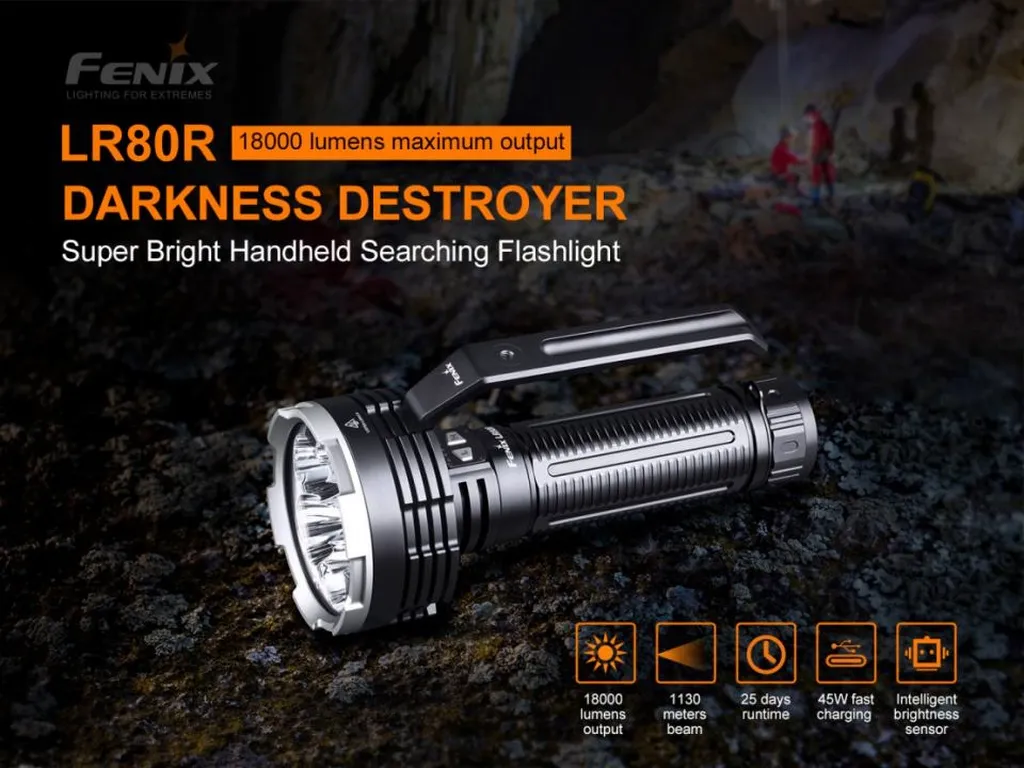
- Most usable output: LR80R — 18,000 lm, and 12,000 lm on the step below, $616.95
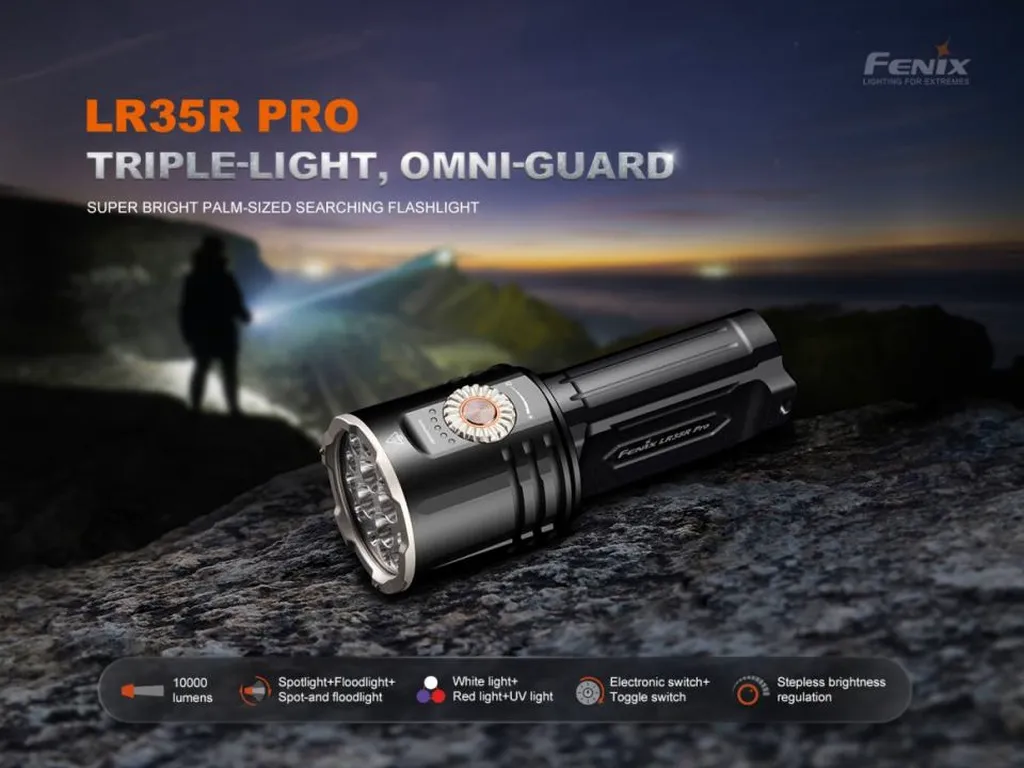
- Best balance of output and price: LR35R PRO — 10,000 lm, $334.95
- Brightest you will actually carry: C7 Pro — 4,600 lm, $134.95
- Every light on this page is over $99, so all of them ship free within Canada.
Looking for reach rather than output? Brightness and beam distance are different specs, and the leaderboards barely overlap — a 500-lumen light in this catalogue out-throws an 18,000-lumen one. That list is in the longest-throw Fenix flashlights.
What “brightest” actually measures
Lumens measure total light leaving the flashlight — every photon in every direction, added up. They say nothing about where that light goes. A 10,000-lumen light with a wide flood beam and a 10,000-lumen light with a tight spot beam put out identical lumens and behave nothing alike. Beam distance and candela describe reach; we cover those in how to read a beam spec sheet.
The second thing worth knowing is how runtime is measured. Under the ANSI/NEMA FL1 standard, runtime runs from switch-on until output falls to 10% of the initial value. So a turbo mode listed at “21,000 lumens, 1 h 50 min” does not mean 21,000 lumens for 1 h 50 min. The light starts there, steps down as it heats, and the clock stops when it finally drops below 2,100.
Every mode below turbo is measured the same way, so none of these figures is a promise of flat output either. What the step below turbo does tell you is where the manufacturer positioned the light to work rather than sprint — and comparing that number across models separates the lights that were built around a headline from the lights that were built around a job. It is the column in the table below, and it reorders the ranking.
The brightest Fenix flashlights, ranked
| Rank | Model | Max lumens | Next mode down | Beam distance | CAD |
|---|---|---|---|---|---|
| 1 | LR60R | 21,000 | 6,000 lm over 3 h (camping high) | 1,085 m | 589.95 |
| 2 | LR80R | 18,000 | 12,000 lm over 2 h 15 min | 1,130 m | 616.95 |
| 3 | LR50R V2.0 | 18,000 | 9,000 lm over 3 h 14 min | 846 m | 539.95 (pickup only) |
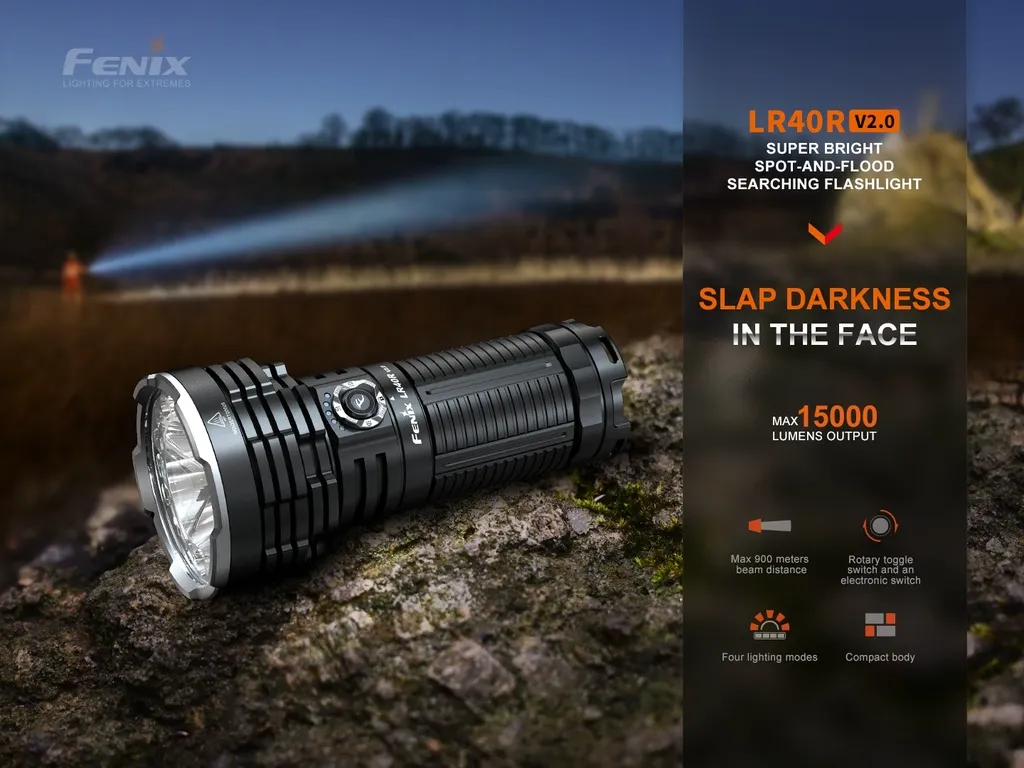
| 4 | LR40R V2.0 | 15,000 | 10,000 lm over 2 h 30 min | 900 m | 419.95 |
| 5 | LR35R PRO | 10,000 | 8,000 lm over 2 h 40 min | 500 m | 334.95 |
| 6 | LR35R | 10,000 | 3,000 lm over 1 h 35 min | 500 m | 273.95 |
| 7 | TK28R | 6,500 | 2,000 lm over 4 h | 400 m | 319.95 |
| 8 | TK35R | 5,800 | 2,000 lm over 3 h 15 min | 610 m | 289.95 |
| 9 | C7 Pro | 4,600 | 2,000 lm over 2 h 12 min | 339 m | 134.95 |
All figures are manufacturer ANSI/NEMA FL1 specifications. “Next mode down” is the highest regulated setting below turbo, with its own ANSI runtime — not a guarantee of flat output.
Two things jump out of that table. The light with the biggest headline number is not the light with the most output underneath it — the LR80R's next step down is 12,000 lumens over 2 h 15 min, where the LR60R's is 6,000 over 3 h. And the gap between rank 5 and rank 6 is enormous despite an identical 10,000-lumen claim: the LR35R PRO steps down to 8,000 lumens, the older LR35R to 3,000.
The LR36R is absent on purpose. It is a 10,000-lumen light, but it is built around a white-laser channel and its reason to exist is a 1,260 m beam, not its output. It leads the throw ranking instead.
Which one to actually buy
Most total output — Fenix LR60R
21,000 lumens, a 1,085 m beam, and an OLED display that reads out brightness, battery percentage and remaining runtime in real time. The rotary switch is the part people underestimate: you change modes by feel, at a glance, with gloves on, instead of clicking through a sequence. It runs a 14.4 V / 4,000 mAh ARB-L56-4000 pack with USB-C charging, IP68 sealing, and a detachable handle for extended carry. It also weighs 1.5 kg — this is a searchlight, not a flashlight you pocket.
Worth knowing: the LR60R runs two separate mode families. Search modes prioritise reach — 1,085 m at turbo, and 1,000 m on search high at 3,000 lumens over 3 h 45 min. Camping modes spread the same power into a wide flood at 15,000 lumens and 352 m. Same light, two completely different tools.
Most usable output — Fenix LR80R
If you are going to be working under the light rather than admiring it, this is the pick. 18,000 lumens at turbo, but the number that matters is the step below it — 12,000 lumens rated over 2 h 15 min, then 6,000 lumens over 2 h 50 min. It is also the longest-throwing light on this page at 1,130 m and 318,000 candela, and it drops to a 50-lumen eco mode rated for 300 hours — which makes it a credible emergency light as well as a searchlight. The 12,000 mAh ARB-L40-12000 pack is what buys all that; so is the 1,636 g on the scale.
Best balance of output and price — Fenix LR35R PRO
10,000 lumens in a 457 g body that fits a palm, for $334.95. It runs independent spot and flood LEDs, so you can throw 5,000 lumens 500 m down a line, flood 8,000 lumens across a work area, or run both at once. It takes a standard replaceable ARB-L21-6000 21700 cell rather than a proprietary pack — meaning the light outlives its battery. For most buyers this is the sensible top of the range.
Brightest light you will actually carry — Fenix C7 Pro
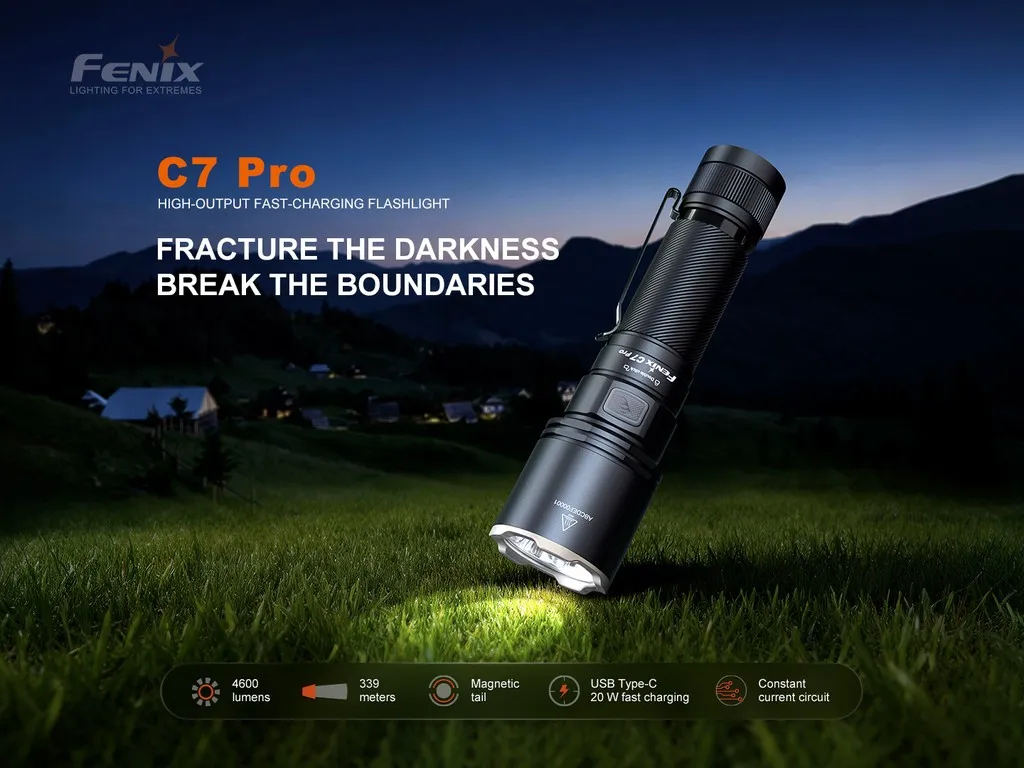
4,600 lumens, 262 g, $134.95. A quad-LED floodlight with an 87° beam, a magnetic tailcap, and 20 W USB-C fast charging. It will not reach across a field — 339 m is the honest figure — but for a vehicle kit, a job site, a garage, or a power outage, a wall of light at close range beats a pencil beam every time. The best output-per-dollar on this page by a wide margin.
Brightest hands-free — Fenix HP35R
4,000 lumens on a head strap with a 10,000 mAh pack, spot and flood emitters, 450 m of reach, a 2 m impact rating and IP68 sealing. It is rated 1,200 lumens over 8 hours — a full shift — and 400 lumens over 18. If both hands need to be doing something else, raw handheld output is irrelevant. The rest of the range is on the headlamps page.
Brightest area light — Fenix CP50R
5,500 lumens from a lantern, which is a strange sentence until you have tried to light a campsite, a driveway or a work area with a flashlight. Spot and flood together reach 450 m; flood alone is rated 3,000 lumens over 8 h 20 min, and a 10-lumen setting runs for 240 hours. IP66 rather than IP68, so treat it as weatherproof rather than submersible.
What high output costs you
Every light on this page trades something for its lumens, and the trade is worth understanding before you spend.
- Weight. The top three are 1,149–1,636 g with batteries. That is a two-handed tool on a lanyard or a shoulder strap, not something that rides in a jacket pocket.
- Heat. Turbo on a 15,000-lumen light is a thermal event. The light manages it by stepping down, which is correct behaviour — but it means you should buy on the mode below turbo, not the headline.
- Battery lock-in. This is the one buyers miss. The LR40R V2.0 has a built-in 3.6 V / 15,000 mAh pack you cannot replace at all. The LR60R, LR80R and LR50R V2.0 run purpose-built removable packs — replaceable, but only with that part. The LR35R PRO, LR35R, TK35R, TK28R and C7 Pro all take standard 18650 or 21700 cells you can buy anywhere and carry a spare of. Decide which of those three tiers you are comfortable with before you compare lumens.
- Runtime at the top. None of these lights run at maximum for a shift. If you need brightness for eight hours, you are buying a mid-range light with a big battery, not a big light on turbo.
One stock note: the LR50R V2.0 is currently available for pickup at our Mississauga location only rather than shipping nationally — contact us before ordering if you are outside the GTA. Everything else on this page ships across Canada, and since every light here is over $99, shipping is free.
How to choose
- Decide whether you need output or reach first. They are different purchases. Wide-area work, vehicle kits, campsites and job sites want lumens. Identifying something across a field or a bay wants candela — see the throw list.
- Read the second brightest mode, not the first. It is the one you will use. The turbo figure sells the light; the mode below it is the light.
- Match the battery to the job. Purpose-built packs deliver the highest output. Standard 21700 cells mean you can carry a spare and keep working. A sealed built-in pack means neither.
- Check the beam, not just the total. 4,600 flood lumens at 339 m and 3,700 spot lumens at 1,100 m are wildly different tools. The beam spec guide covers how to tell them apart on paper.
- Buy the weight you will carry. A 1.6 kg searchlight left in the truck is dimmer than a 260 g light in your hand.
The full high-output range lives on the search lights page, with duty and patrol models on tactical lights. Every light here is covered by the Fenix warranty with service handled in Canada — you can check coverage and register a repair on our support page. Kitting out a crew or a SAR team? Volume orders get consistent equipment and pricing across the group, and you can contact us for a recommendation against your actual use case.