Night Fishing Lights: The Two-or-Three-Light Setup for Canadian Water
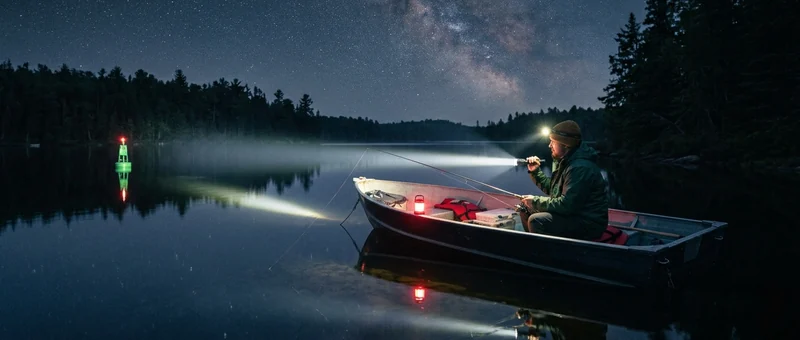
You're rigging jigs at 11 pm on a northern Ontario lake, one hand on the line, the other digging through the bottom of the tackle box for the right hook. The headlamp handles that. Thirty seconds later you need to scan the channel marker 200 metres out to stay in the legal zone — the headlamp barely reaches. The net needs wide light; the shoreline needs a tight beam; the tackle tray needs hands-free access. These are three different lighting jobs, and they don't share well. The two-or-three-light setup solves that.
Why one light fails on the water
Night fishing has a geometry problem. Close-range tasks — tying a knot by feel, landing a fish in the net, finding the scissors — need wide, manageable flood coverage that doesn't blast your night vision or broadcast your position. Scanning structure, picking out channel markers, or checking whether you've drifted requires reach: a tight, long-distance beam with meaningful candela. A single light built for one job fails at the other.
A headlamp optimized for hands-free close work doesn't have the throw for serious water scanning. A long-range handheld can't mount on a headband, and it's too large to hold one-handed while you work line. The three-light approach assigns each job to the right tool and accepts no compromise on any of them.
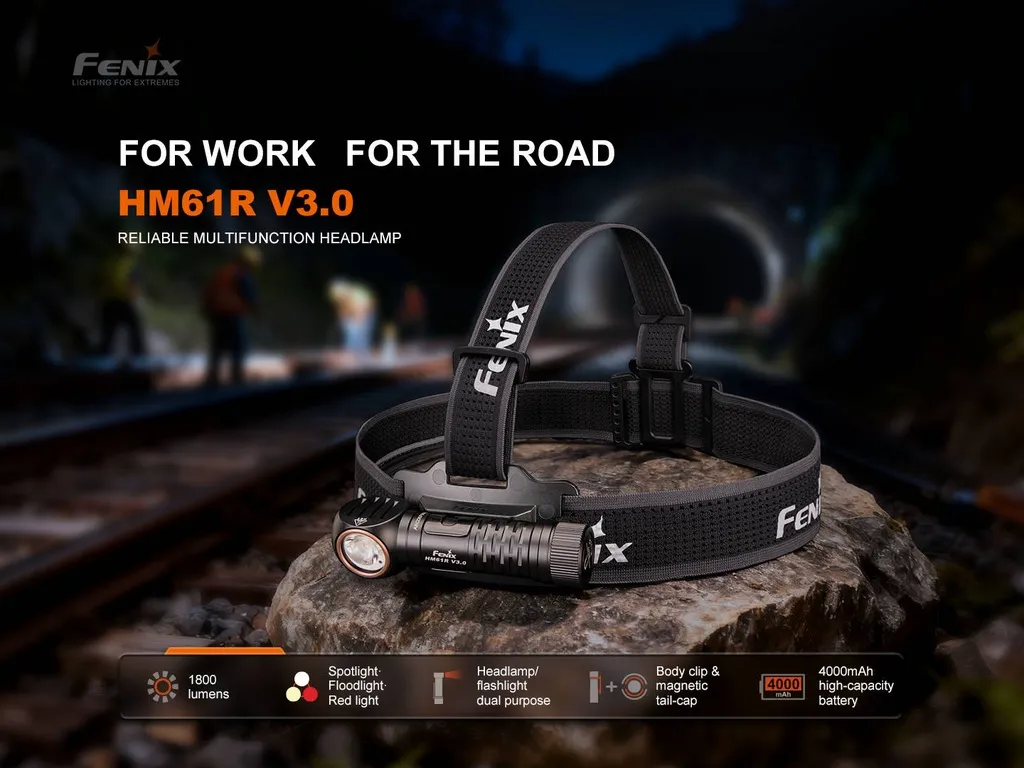
The headlamp — HM61R V3.0
Most headlamps do one thing: mount to your head and aim where you look. The HM61R V3.0 does something different. The flashlight module lifts out of the headband bracket — instantly converting from a mounted headlamp to a compact handheld. Rig it on your head while you tie on tackle; pull it from the bracket when you're landing a fish and need to direct the beam precisely without moving your whole head. One light, both roles, no second carry.
On the headband, Spot Turbo delivers 1,800 lumens on a 195 m beam (9,540 cd peak intensity) — enough reach to check structure well past where most casts land. Spot High at 600 lumens throws 107 m, useful for reading nearby water or identifying what's coming toward the boat. Spot Med at 150 lumens and 53 m is the practical all-evening fishing mode: enough to see the deck, work the tackle box, and tie knots without advertising your position across the lake. Spot Low at 30 lumens is close-work only. Red mode preserves night adaptation between tasks. Included cell: ARB-L18-4000U 18650. IP68 rated.
| Mode | Output | Beam Distance |
|---|---|---|
| Spot Turbo | 1,800 lm | 195 m |
| Spot High | 600 lm | 107 m |
| Spot Med | 150 lm | 53 m |
| Spot Low | 30 lm | — |
Want more headlamp output? The HM65R V2.0 adds a dedicated floodlight alongside the spotlight for 2,200 lumens combined — a brighter, dual-source alternative if you don't need the detachable module feature.
The focusable beam — LD45R
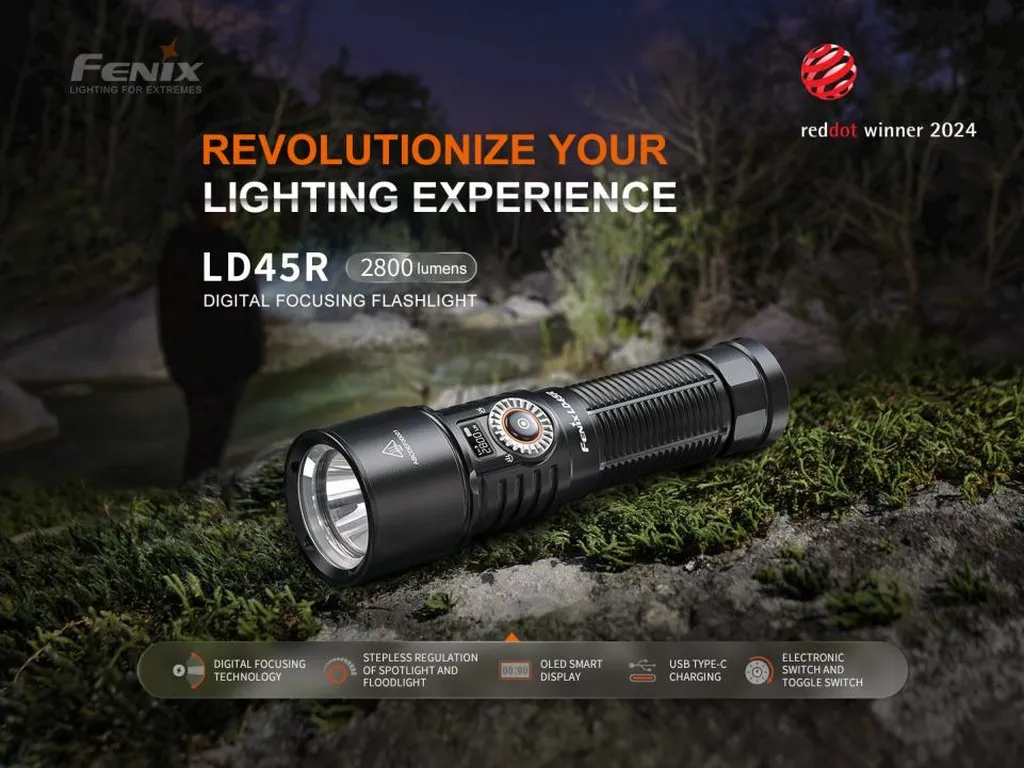
The LD45R is built around digital focusing — a zoom mechanism that shifts from a wide flood to a tight throw on demand, without switching light modes. Set it to flood and you have a wide pool of light covering the full deck, the net, and both sides of the boat. Narrow it to spot and the same light becomes a 480 m beam at 57,600 candela — enough to read a channel marker, pick out a buoy, or identify what the sonar just showed you on the bottom structure.
That's the fishing argument: flood for boat work, spot for the water, one light doing both. High at 1,000 lumens reaches 289 m; Med at 350 lumens covers 173 m. You're not carrying two lights for two distance jobs — you're carrying one that switches between them in a second. IP68. Whatever the weather does on open water, the LD45R handles it.
| Mode | Output | Beam Distance |
|---|---|---|
| Turbo | 2,800 lm | 480 m |
| High | 1,000 lm | 289 m |
| Med | 350 lm | 173 m |
The pocket handheld — PD35R ACE
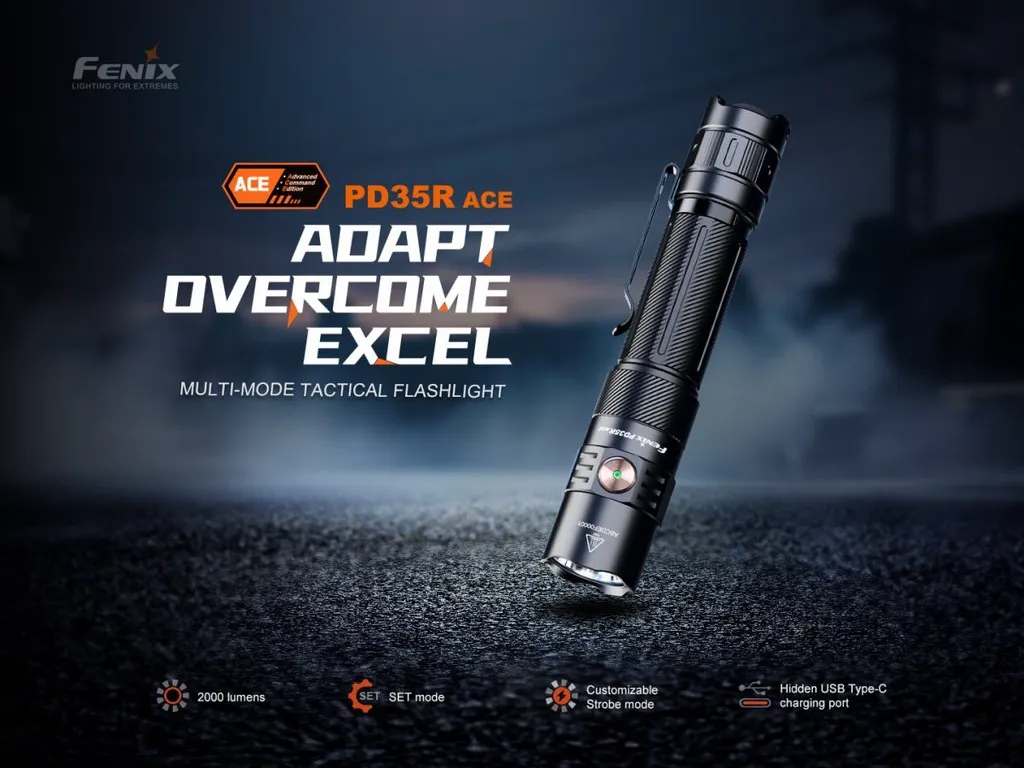
The PD35R ACE earns its place in the tackle bag by being the one that's always at hand. It fits a jacket pocket cleanly and works one-handed — no second thought when you need light quickly and both the headlamp and LD45R are already deployed elsewhere.
Turbo at 2,000 lumens and 380 m (33,872 cd) handles anything from scanning a far bank to a sudden task requiring maximum output. Med at 350 lumens and 147 m is the practical workhorse mode. ECO at 1 lumen runs for 720 hours — a reserve mode that keeps any light alive long past when the cell would otherwise be dead. It runs on an ARB-L18-4000U 18650 included in the box and accepts two CR123A batteries as backup if you run dry without charge access. IP68.
| Mode | Output | Beam Distance |
|---|---|---|
| Turbo | 2,000 lm | 380 m |
| Med | 350 lm | 147 m |
| ECO | 1 lm | — |
One side note for lure anglers: the TK35R's 365 nm UV LED will charge glow-in-the-dark jigs and markers — a legitimate fishing use if you already carry one. It's not part of this three-light kit, but worth knowing.
Red mode and light discipline on the water
All three lights in this kit carry red mode. That's the most practical feature for night fishing. Red light preserves night adaptation — the rod-and-cone dark sensitivity your eyes build over 20–30 minutes — which white light destroys in under a minute. After two hours of fishing in the dark, your unaided eyes are genuinely more useful at close range than most lights. White light kills that. Red doesn't.
The practical approach: use red for knot-tying, tackle selection, and anything in the boat that doesn't require distance. Keep white beam output at the lowest effective level for the task. Reserve directed white light for netting, inspecting structure, and reading navigational markers. That discipline preserves your effectiveness as an angler through the whole session.
A brief legal note: night fishing is distinct from night hunting, and the regulations governing each are different. Night fishing is legal across most Canadian freshwater bodies (subject to provincial rules and any applicable conservation area restrictions); night hunting of most species is broadly restricted under provincial wildlife legislation. The lights and techniques described here are configured for fishing. Check your provincial MNR or wildlife authority regulations for your specific water before going out.
Frequently asked questions
What lights do I need for night fishing?
At minimum, a headlamp for hands-free work — tying, baiting, netting — and a handheld for directed tasks. The third piece, a focusable beam, earns its place once you need to scan the shoreline, read channel markers, or identify structure beyond 100 m. The HM61R V3.0 covers the headlamp role and adds a detachable flashlight module that doubles as a compact handheld. The LD45R handles the focusable mid-to-long-range beam with its digital zoom from flood to spot. The PD35R ACE is the fast-access backup that stays in the tackle bag. All three are IP68 and charge over USB-C.
Does light spook fish?
The honest answer: it depends on species, water clarity, season, and how the light is used. Many anglers fish successfully in light-polluted water with no issue; others find fish go quiet under bright white light. What's consistent in the evidence: sudden, intense white light directed at the water surface tends to drive fish deeper or shift their position in clear, calm conditions. Red light in the 620–750 nm range is not strongly perceived by most Canadian freshwater species. The practical approach is consistent with good night-vision discipline anyway — use red mode for boat tasks, keep your white beam off the water when working line, and point directed white light at the water only for netting and inspections. That way you protect your own dark adaptation and reduce any light impact on fish at the same time.
Are these lights waterproof enough for a boat?
All three — HM61R V3.0, LD45R, and PD35R ACE — are IP68 rated. That means complete dust protection and continuous submersion to a manufacturer-specified depth and duration, typically 2 metres for 30 minutes. In practical boat terms: rain, spray, splash, overnight dew, and the light going overboard in shallow water are all covered. These are not designed for deep diving under sustained pressure, but for open-boat fishing on Canadian water — lakes, rivers, coastal inlets — they are waterproof in any condition you are likely to encounter.