Construction Inspection Lights: What the Standards Require, and What Inspectors Actually Carry
Most flashlight guides written for trades are lumen contests. Inspection doesn't work that way. An inspector isn't trying to light up a field — they're trying to make a defect visible: a hairline crack in a foundation wall, a blister under a coating, the reflection off a few millilitres of water where water shouldn't be. That job has real numbers attached to it, and most of the lighting advice online gets those numbers wrong.
This guide covers what the codes actually require (and the widely repeated figures that aren't in any code), the raking-light technique that finds surface defects, and the Fenix lights Canadian inspectors carry. Everything ships from Mississauga, Ontario with the full Fenix warranty, and teams buying multiple units can go through volume orders.
What the codes actually require
There is no single “construction inspection” lighting standard. What exists is a set of task-specific requirements, and which one applies depends on what you're inspecting.
| Standard | What it requires | Applies to |
|---|---|---|
| ASME BPVC Section V, Article 9 (T-952) | 100 foot-candles (1,076 lux) at the examination surface, eye within 600 mm (24 in), line of sight not less than 30° to the surface. The light source and technique must be demonstrated and documented once, on file. | Direct visual examination — pressure vessels, boilers, code welds |
| ASTM E165 | 100 foot-candles (1,076 lux) at the surface for visible dye penetrant. | Liquid penetrant inspection, visible dye |
| ASTM E1417 | 1,000 µW/cm² of UV-A irradiance measured at 15 in (38 cm), with ambient white light held to 2 fc (21.5 lux) or less at the surface. | Fluorescent penetrant inspection |
| ISO 17637 | Minimum 350 lux, 500 lux recommended; same 600 mm / 30° viewing geometry. | Visual testing of fusion-welded joints |
| O. Reg. 213/91, s. 45 (Ontario Construction Projects) | Every part of a project where a worker may be must be “adequately lit.” No lux value appears anywhere in the regulation. | Ontario construction sites, generally |
Two numbers you'll see quoted that aren't in the code
- AWS D1.1 does not set a lighting minimum. Clause 6.5.3 asks that visual testing for cracks be “aided by a strong light, magnifiers, or other devices.” “Strong” is never defined. There is no foot-candle or lux figure in the structural welding code.
- The 500 lux figure is ISO 17637's, not AWS's or API's. It gets attributed to both constantly. ISO 17637 sets 350 lux as the floor and recommends 500 — and note that the North American pressure-equipment and penetrant codes are roughly twice as strict at 1,076 lux.
Ontario's regulation is worth reading carefully, because “adequately lit” means the number isn't handed to you. The Ministry's own guidance points assessors at published lighting practice rather than a regulatory table, and CCOHS puts precision assembly and inspection work in the 750-lux-and-up range depending on how fine the detail is. That's guidance, not law — but it's the guidance an inspector's report gets measured against.
One certification note for Canadian readers: NDT personnel here are certified under CAN/CGSB-48.9712 (the Canadian implementation of ISO 9712) through NRCan, not the American SNT-TC-1A framework. Either way, the lighting minimum comes from the governing code — ASME, ASTM, ISO — never from the certification scheme.
The requirement nobody codified: colour
Read those standards again and notice what they all have in common. Every one of them regulates how much light. Not one of them regulates what kind. There is no welding code, NDT standard, or building regulation in Canada that sets a minimum colour rendering index.
That silence is a problem, because colour is how you read rust bloom against mill scale, how you tell a hairline crack from a pencil line, and how you catch the difference between a coating cured properly and one that flashed off. Under a low-CRI cool-white LED, those distinctions flatten out. High-CRI light around 5000 K is recommended practice in coating and finish inspection specifically to avoid metamerism — two surfaces that match under one light source and diverge under another. Where colour matching is formally assessed, ASTM D1729 and ISO 3668 call for D65 daylight-simulating light rather than naming a CRI number.
So: recommend high CRI, don't call it a requirement. And be careful who claims it — “neutral white” on a spec sheet is not a CRI rating. In the Fenix line, three models state a genuine high-CRI emitter in their specifications: the HM61R V3.0 (OSRAM 1414 CRI90 flood), the HM60R V2.0, and the HP35R. The rest are excellent working lights that we are not going to pretend are colour-critical instruments.
Raking light: the technique that finds the crack
This is the part almost no lighting guide covers, and it's the difference between an inspector who finds surface defects and one who walks past them.
Pointing a bright light straight at a wall is the worst way to inspect it. Light arriving perpendicular to a surface fills the defect with light and washes out the very shadow that reveals it — and on concrete, polished metal, or wet surfaces it comes straight back at you as glare.
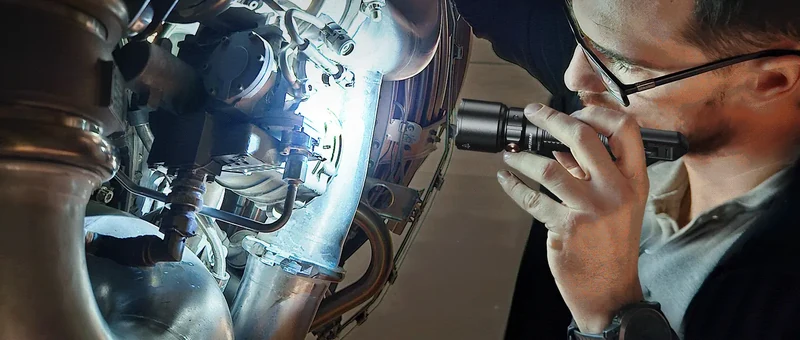
Raking light — also called grazing or oblique illumination — is the fix. Hold the light low and nearly parallel to the surface, roughly 5–15°, and every bit of relief throws a shadow across the plane. Cracks, pits, blisters, tears, sanding scratches, weld undercut, and lifted coating all pop into view as long, dark lines that were invisible head-on. Conservators have formalized this for a century — the CAMEO definition from the Museum of Fine Arts, Boston is the clearest one published — and it's the same physics that weld and tank inspectors use in the field.
Three rules that come out of that practice:
- Make multiple passes from different directions. A crack running parallel to your beam casts no shadow. The defect you miss on the first pass shows up on the second when you move 90° around it.
- Graze for topography, flood for colour. Once the defect is located, switch to broad diffuse light to assess it — wide flood kills the specular glare that grazing light creates on concrete and polished steel, and lets you read staining, corrosion, and colour change accurately.
- Use reflection deliberately. Experienced foundation and crawlspace inspectors work off the reflection: a low, raking beam skimming a slab lights up standing water and damp patches as bright specular flashes long before the eye picks up a colour difference in the concrete. It's a white-light technique — you don't need UV for it.
What this means for buying: the light that does inspection well is the one that can do both jobs — a tight beam you can rake across a surface at a low angle, and a genuine wide flood for close assessment. A single-mode wall of turbo lumens does neither.
What inspectors actually carry
| Job | Pick | Why it fits | CAD |
|---|---|---|---|
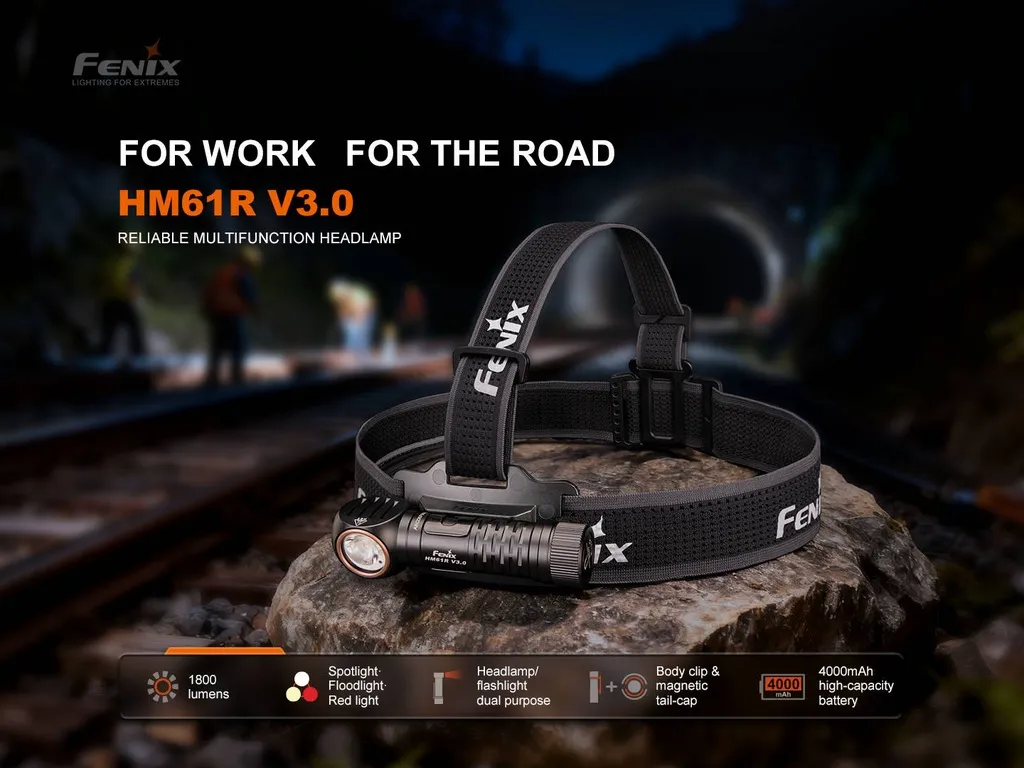
| Close, colour-critical work | HM61R V3.0 | Dual LEDs: a 1,800-lumen throw spot and a separate CRI90 flood (200 lumens for 12 hours) — graze with one, assess with the other. Hands-free, and the lamp detaches and holds on steel with the magnetic tailcap. IP68, 2 m impact rated. | 134.95 |
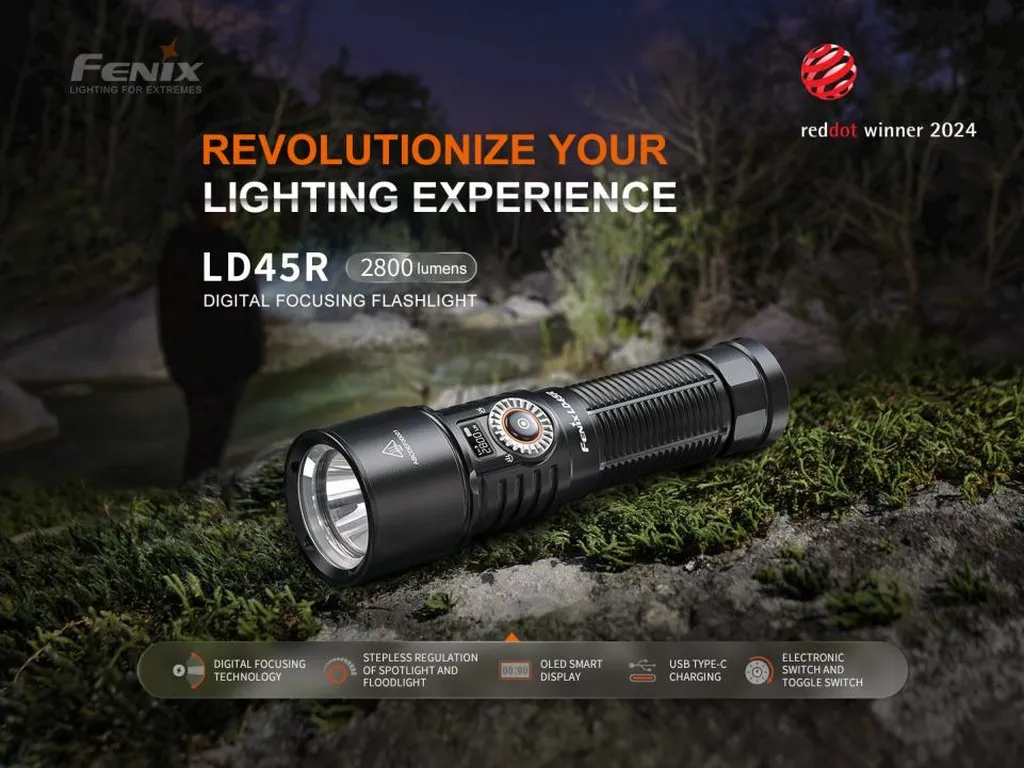
| Structure, ceiling, long throw | LD45R | 2,800 lumens and 480 m of reach, with a rotating toggle that focuses cleanly from spot to flood — one light that rakes a wall and then floods it. The OLED display shows the exact output level and battery state, which matters when your report has to say what you inspected under. | 184.95 |
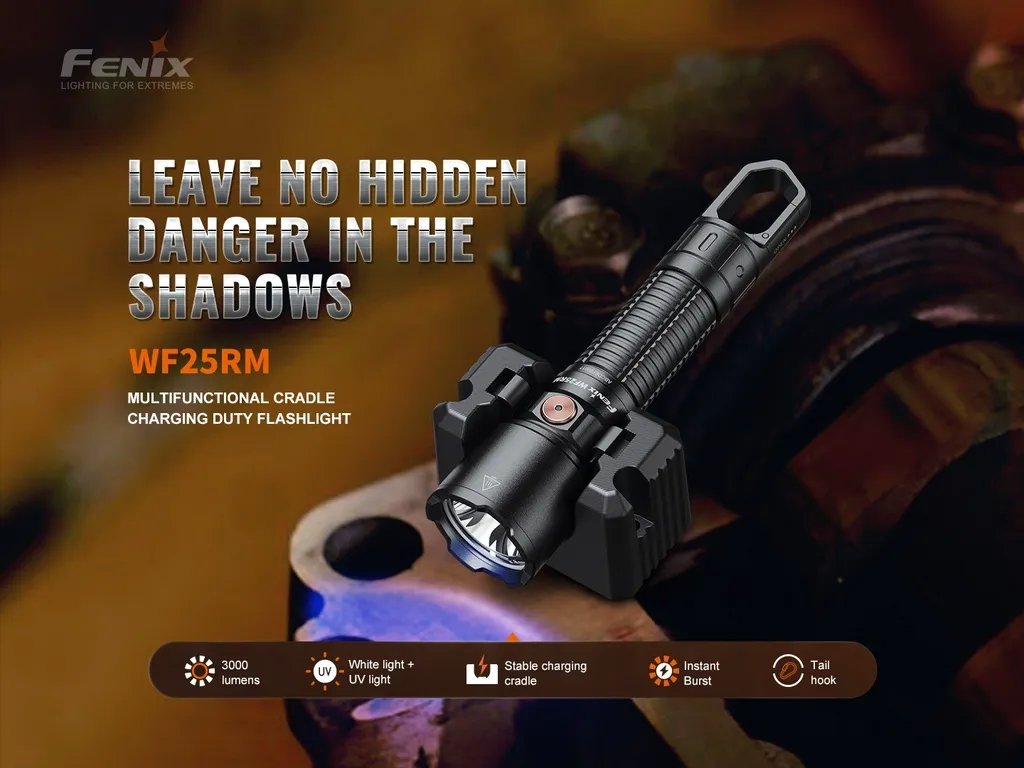
| Site light + dye and leak detection | WF25RM | 3,000-lumen duty light with a built-in 365 nm UV channel for non-destructive and leak testing, plus a magnetic charging cradle that keeps it docked and charged between jobs. | 204.95 |
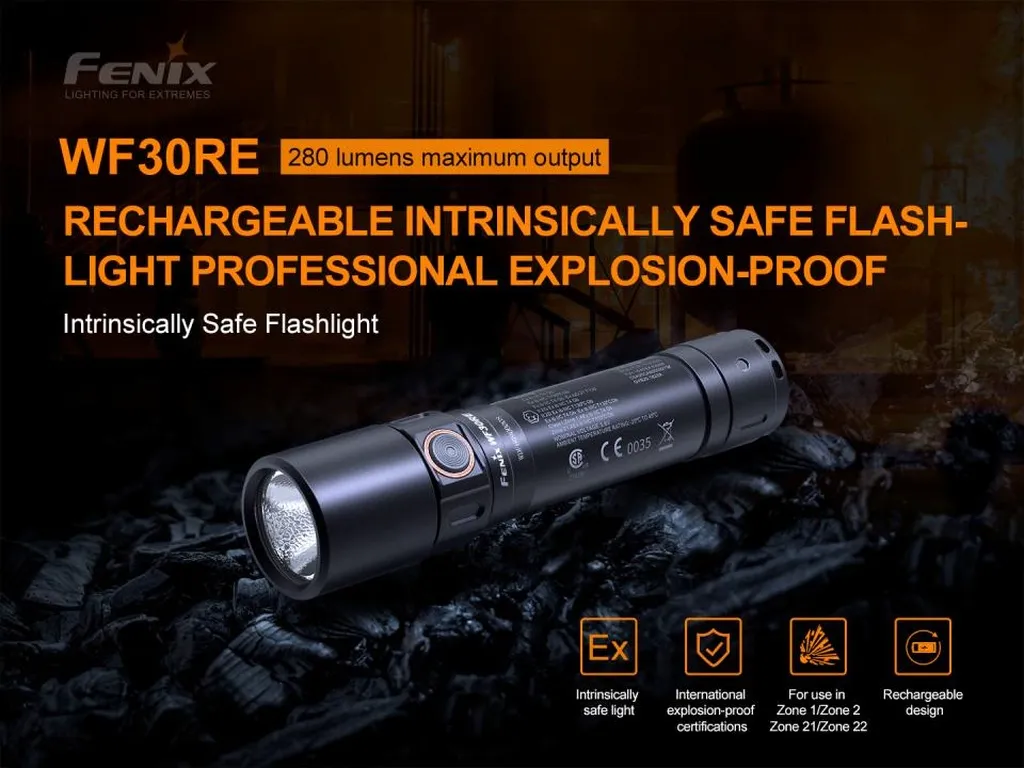
| Confined space, gas present | WF30RE | Intrinsically safe, certified ATEX + IECEx + CSA + NEPSI for explosive gas zones and combustible dust areas. 280 lumens is plenty when the alternative is not being allowed to carry a light at all. | 137.95 |
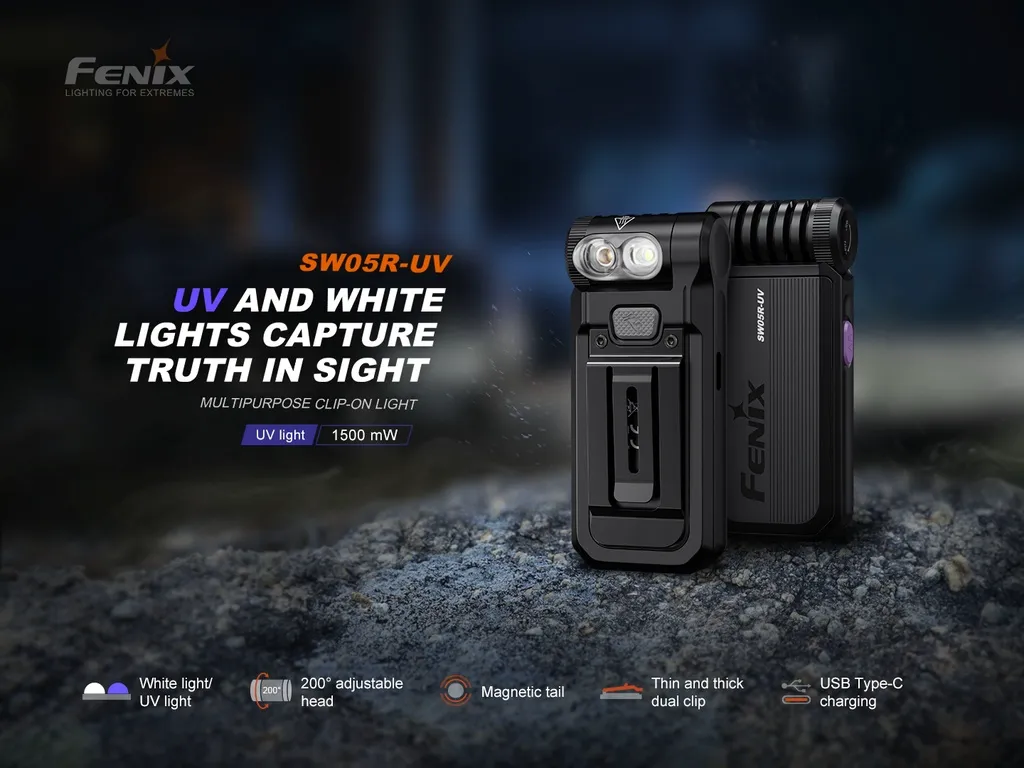
| Pocket / penlight | SW05R-UV | 150-lumen white plus a 365 nm UV source in a 55 g body, with a 200° adjustable head — angle it down to rake a surface without contorting your wrist. Magnetic tail and a clip for hands-free. | 68.95 |
A word on UV
UV earns its place in fluorescent penetrant work, dye leak testing, and HVAC refrigerant tracing — jobs where the standard actually specifies it. It is not a general-purpose crack finder. Concrete cracks and foundation water are found with raking white light, not fluorescence. Where UV does apply, wavelength matters: the WF25RM, SW05R-UV, and LR35R PRO all use true 365 nm sources rather than the cheap 395 nm violet LEDs that mostly just make things look purple. And ASTM E1417 is explicit that the UV reading is irradiance — 1,000 µW/cm² at 15 inches — measured with a meter, not estimated from a lumen figure.
Hazardous locations: the one place the choice is made for you
If the atmosphere can be flammable — Class I Division 1 in Canadian Electrical Code terms — then the light must be certified for it, full stop. That means CSA certification under CEC Section 18, and there is no lumen count that substitutes. The WF30RE carries ATEX, IECEx, CSA and NEPSI approvals; see the full intrinsically safe range. Everything else in this guide stays outside the classified zone.
How to actually choose one
The specs that matter for inspection are not the ones on the front of the box:
- Sustained output, not turbo. A 3,000-lumen peak that thermally steps down after ninety seconds is useless on a two-hour walkthrough. Read the runtime on the mode you'll actually work in — for close inspection at one to three metres, that's usually a few hundred lumens, not the maximum.
- A switch you can work without thinking. If the light needs a memorized button sequence to change modes, it will get used on one mode forever. Simple interfaces win on a job site.
- USB-C and a replaceable cell. A light with a sealed proprietary battery becomes a paperweight the day the cell dies. Every model above except the intrinsically safe WF30RE (whose certified battery pack is a condition of the approval) runs a standard replaceable cell.
- Impact and IP rating, honestly stated. The lights above are rated to 1–2 m of impact and IP68 sealing — excepting the SW05R-UV, which is IPX6. A light that dies at nine months on a site was never rated for a site.
Speccing lights for a crew or a whole inspection team? Volume orders get pricing and consistent kit across the team, and you can contact us for a recommendation against the specific standard you work to. The whole professional range lives on the work lights page.